

.avif)

This year’s SuiteWorld felt like a turning point.
You could feel it in the hallway chatter, the keynote stage, and even in the late-night conversations with other NetSuite partners.
Everyone was talking about AI, but this time it didn’t feel abstract.
It felt practical.
Tangible.
Within reach.
For us at Stockton10, SuiteWorld 2025 wasn’t just another industry event. It was a sign that the work we do every day with our clients is moving into a new phase.
What SuiteWorld 2025 Was Really About
Over 8,000 attendees gathered in Las Vegas for Oracle NetSuite’s biggest event of the year. The theme: “No Limits: AI-Powered Business.”
And for good reason.
This year’s announcements didn’t just promise innovation. They showed how AI will quietly slip into the background of how NetSuite already runs.
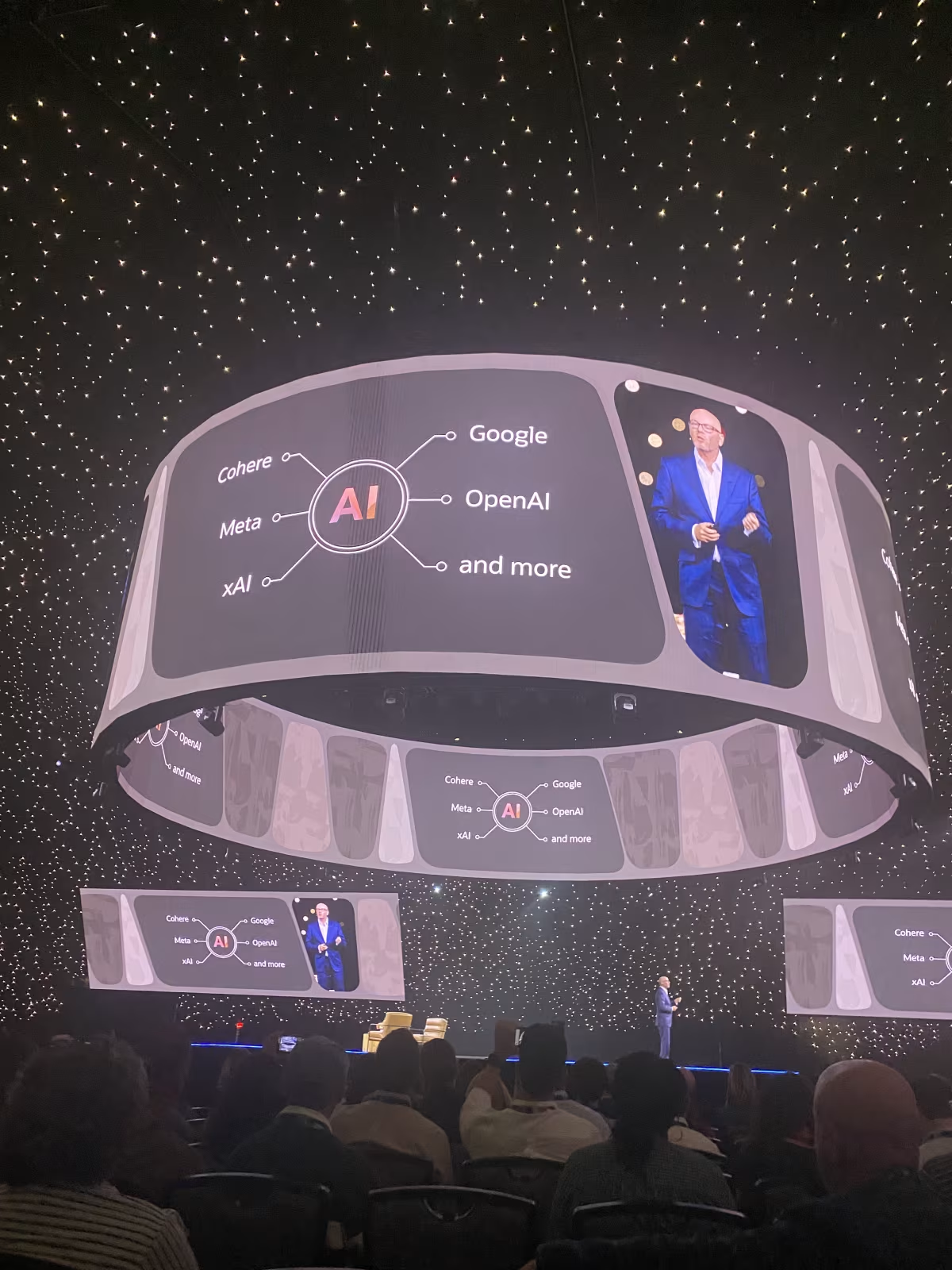
What was announced at SuiteWorld 2025
- NetSuite Next: A redesigned interface that introduces AI into the core system. Think faster navigation, cleaner dashboards, and smarter workflows that make day-to-day work easier.
- Ask Oracle: An AI assistant built into NetSuite. You can ask questions like “Which invoices are overdue?” or “Add a column to this saved search,” and it acts immediately. No more coding or complex prompts.
- Native Bill.com integration: Finally, accounts payable automation directly inside NetSuite. One login. One workflow.
- Autonomous close previews: AI that helps handle reconciliations, accruals, and reviews at month-end. Still early, but it’s a big step toward intelligent accounting.
Key Announcements from SuiteWorld 2025
SuiteWorld’s keynote wasn’t about distant promises; it showed tangible steps toward an intelligent ERP.
After two years of anticipation, AI in NetSuite finally feels real.
NetSuite Next: The next generation of ERP
Oracle called this “the biggest announcement in NetSuite’s history.” NetSuite Next represents a new architecture and a genuine rethinking of how users interact with data.
Oracle emphasized that NetSuite Next is still in limited preview, with a broader rollout expected in 2026.1 or 2026.2.
Current demonstrations show early builds running side-by-side with existing environments, allowing users to toggle between classic NetSuite and the new interface during transition.
What we liked:
- Actionable AI: Ask Oracle doesn’t just fetch data; it can summarize reports, create saved searches, or trigger actions.
- Cleaner UI: Simplified navigation and faster performance throughout.
- Ask Oracle assistant: Type questions in natural language like “What are my top delayed invoices?” and get answers instantly.
Early demos show it can also perform basic actions such as adding columns to saved searches and generating simple reports, though full automation capabilities are still in development.
This moves AI inside NetSuite’s core, reducing clicks and manual effort for finance, operations, and IT teams.
Oracle Cloud Infrastructure (OCI): Faster and stronger foundations
NetSuite Next now runs on OCI, Oracle’s cloud backbone.
Running on Oracle Cloud Infrastructure means better speed and uptime for clients who process large transaction volumes.
Expected benefits:
- Higher transaction throughput: Handles larger data sets without lag.
- Faster responsiveness: Improved performance under peak load.
- Enterprise-grade reliability: Better uptime and stronger data protection.
OCI makes NetSuite more resilient for high-growth companies handling large transaction volumes.
Oracle didn’t cite specific benchmarks during the keynote, but partner sessions confirmed measurable gains in throughput and latency during internal testing.
Bill.com Integration: Simplifying payables
Oracle announced a built-in accounts-payable automation through Bill.com.
What this brings:
- Simpler approvals and payments without leaving NetSuite.
- Less manual entry for AP teams.
- Flexible scalability for companies who may later integrate enterprise tools like Tipalti.
Finance teams gain real automation instead of just faster spreadsheets.
Bill.com’s integration targets small to midsize companies; larger enterprises may continue using solutions like Tipalti or Coupa for multi-entity control.
AI Connector Service (Preview)
Oracle previewed an upcoming AI Connector Service built on the emerging Model Context Protocol (MCP) standard.
This will allow secure, simplified connections between NetSuite and external AI systems or partner-developed assistants without heavy scripting.
While still in early preview, it signals Oracle’s intent to open NetSuite’s AI layer to a broader ecosystem of extensions.
Industry-Focused AI: Vertical intelligence gets sharper
Oracle reinforced its verticalization strategy, tailoring AI capabilities to specific industries instead of generic automation.
Sector improvements include:
- Professional Services: Smarter forecasting, resource optimization, and project profitability insights.
- Manufacturing: AI-based production tracking and predictive maintenance.
- Software and SaaS: Subscription management dashboards and churn analytics.
Every workflow gains contextual intelligence built around how each industry actually operates.
Oracle described this as “verticalized AI,” where forecasting, planning, and automation models are trained on sector-specific data, not one generic engine across all users.
How NetSuite Next Turns AI From Hype to Action
Earlier AI experiments in NetSuite relied on external add-ons. NetSuite Next brings it into the platform.
In practice:
- Ask Oracle acts as a built-in analyst for finance and operations.
- It understands plain English, not code or complex prompts.
- It supports real-time decisions without exporting data elsewhere.
Why users liked it: It learns from your phrasing, adapting to how your team speaks instead of the other way around.
Performance and Scalability on OCI
The move to Oracle Cloud Infrastructure signals long-term investment in speed and reliability.
What users can expect:
- Faster reporting cycles during high-volume periods.
- Better stability for multi-subsidiary setups.
- A smoother experience for distributed teams across regions.
It’s a quieter change than flashy AI demos but arguably more valuable for companies scaling fast.
Vertical Intelligence: AI That Understands Your Industry
Rather than a single AI model for everyone, Oracle’s direction is “vertical depth.”
That means:
- Industry-tuned algorithms for finance, operations, and forecasting.
- Workflows pre-configured for common sector processes.
- Insights built around your actual data patterns.
AI is becoming less abstract and more grounded in daily business use.
Stockton10’s Takeaways from SuiteWorld 2025
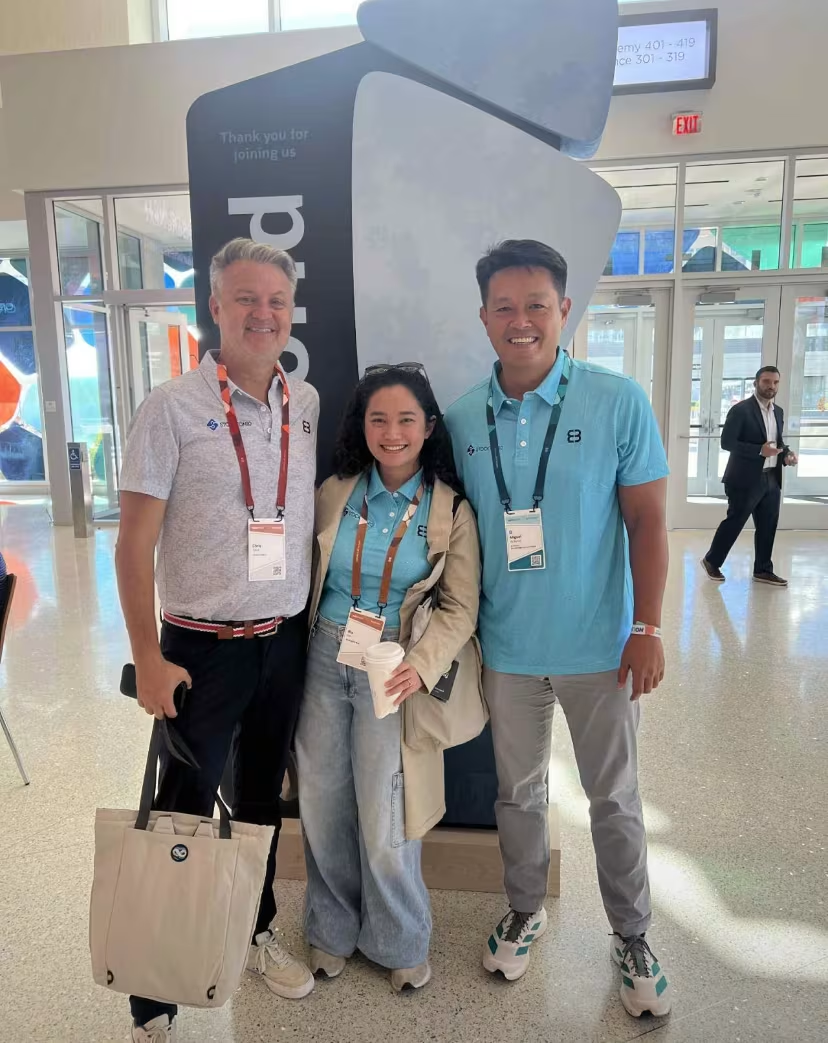
Our team went to SuiteWorld asking one question:
How can AI make NetSuite environments cleaner, faster, and safer for our clients?
The sessions reinforced what we already know. Technology only works if the process behind it does.
Here’s how we see things shifting:
1. Automation follows structure
AI can’t fix messy workflows—it multiplies them.
Our Process-Driven Optimization approach focuses on:
- Clarifying steps: Documenting how work actually gets done.
- Removing bottlenecks: Eliminating unnecessary handoffs.
- Defining ownership: Ensuring accountability before automation.
Well-structured systems are the foundation for reliable AI results.
2. Integrations are evolving from connections to conversations
Traditional integrations move data. Modern integrations interpret it.
What’s next:
- Connected platforms that flag exceptions automatically.
- Context-aware systems that understand impact, not just numbers.
- Predictive recommendations based on cross-system trends.
At Stockton10, our Connected Systems Ecosystem focuses on integrations that help data “talk,” not just transfer.
3. Support is shifting toward enablement
AI will change what support means. Instead of fixing tickets, the focus is moving to guiding decisions and preventing issues.
Our Expert-Led Managed Support model now includes:
- AI-assisted diagnostics for faster triage.
- Automated reports highlighting optimization opportunities.
- Predictive monitoring to prevent recurring problems.
Support is becoming proactive = less waiting, more continuous improvement.
Other Product Updates Worth Watching
Beyond the headline announcements, a few smaller but meaningful updates stood out.
NetSuite Next Release Timing
Oracle hasn’t announced a firm release date, but insiders expect 2026.1 or 2026.2.
What companies should do now:
- Review current SuiteScript and custom pages for compatibility.
- Identify dependencies on the legacy UI.
- Budget time for testing once early access opens.
Early planning prevents expensive problems later.
Oracle partners anticipate early testing programs will begin mid-2025, giving developers time to validate custom pages and SuiteScript compatibility before the full cutover.
Bill.com Integration in Action
The Bill.com integration drew significant interest because it solves a daily pain point.
AP benefits include:
- Built-in payment scheduling and reconciliation.
- Automatic sync between NetSuite and Bill.com records.
- Simplified audit trails for approvals.
This is practical automation. The kind that saves time immediately.
AI Tools Already Available from Partners
Third-party vendors are already extending AI inside NetSuite.
Top demos at the Expo:
- Cauzzy: Report generation and predictive recommendations.
- AI-ERP Labs: Custom workflow assistants.
- 369AI: Analytics and data validation tools.
We’re already testing these tools to determine which ones deliver genuine operational benefits for clients.
What SuiteWorld 2025 Means for CFOs, COOs, and IT Leaders
SuiteWorld 2025 marked a turning point.
AI isn’t a headline anymore. It’s becoming the quiet engine inside every NetSuite account.
CFOs, COOs, and IT leaders each saw how these changes reshape their work. What used to take hours can now happen in seconds.
But the shift isn’t just about speed.
It’s about clarity, control, and smarter use of people’s time.
How CFOs can use AI to optimize financial performance
Finance teams have been promised automation for years. This time, it’s real.
The new AI tools target the pain points that slow down every close cycle.
Where the gains start:
- Faster close cycles: The autonomous close feature reconciles accounts automatically, shrinking days into hours.
- Sharper forecasting: Ask Oracle gives live insights without complex exports or reports.
- Simpler payables: The built-in Bill.com integration removes repetitive approvals and manual entries.
These upgrades don’t replace finance professionals. They clear the clutter so they can think strategically again.
How COOs can apply agentic workflows to scale operations
For operations leaders, SuiteWorld offered a look at what happens when systems start thinking ahead.
Instead of reacting to bottlenecks, teams can now anticipate them.
Here’s what that looks like:
- Automatic handoffs: Workflows move between teams without waiting for manual triggers.
- Early alerts: Predictive analytics catch slowdowns before they reach customers.
- Consistent scaling: AI helps processes stay steady when demand spikes.
The result is simple: fewer surprises, more control.
How IT leaders can prepare for AI-enabled integration
IT leaders are stepping into a new phase. The job isn’t to keep NetSuite running; it’s to make it work harder for the business.
Priorities after SuiteWorld:
- Simplify customizations: Replace scripts with native connectors where possible.
- Use OCI advantages: Faster load times, stronger uptime, and better scalability.
- Upskill early: Oracle’s AI Foundations certification helps teams understand how to implement AI safely.
The best IT leaders will turn stability into progress, making sure every update leads to sharper performance, not more complexity.
3 Steps to Prepare Your NetSuite Environment for AI
SuiteWorld 2025 made one thing clear: AI transformation doesn’t start with a product launch; it starts with better habits inside your system.
The companies that win next year will be the ones cleaning up their workflows now, not waiting for AI to “solve” them later.
These three steps build the foundation for AI that actually works.
1. Audit your month-end and manual workflows
Every NetSuite account has a few repetitive tasks that quietly drain hours every week. Find them.
Start here:
- Month-end reconciliations: Identify where manual matching still happens.
- Vendor invoice approvals: See if routing can be handled by SuiteFlow or AI-based triggers.
- Data cleanup and duplicate checks: Use saved searches or scripts to flag recurring inconsistencies.
Once you’ve listed your top three, ask whether AI, scripted automation, or a connector could take that load off. Small experiments now build confidence for bigger automation later.
2. Map your integration gaps for data conversation
Integrations shouldn’t just move data, they should make it smarter. When systems understand context, you stop reacting and start predicting.
Ask your team:
- Where is data still being transferred manually?
- Which integrations cause rework or double entry?
- Which tools can actually interpret or learn from your data?
Modernize the connections that slow you down most. True “AI in ERP” starts with systems that talk to each other, not just pass numbers back and forth.
3. Plan your AI-enabled managed support strategy
AI won’t replace managed support, but it will redefine what “support” means. The next wave of service focuses on prevention, not repair.
Modern support includes:
- Predictive diagnostics: Catch anomalies before users notice them.
- Automated alerts: Flag issues the moment they start trending.
- Quarterly system assessments: Ensure small inefficiencies don’t turn into major rebuilds.
Define these expectations early with your managed-services provider so progress stays consistent and measurable every quarter.
The Future of NetSuite and the Oracle Ecosystem
SuiteWorld confirmed what many have suspected for years: NetSuite is becoming a deeper part of the Oracle ecosystem.
The new Ask Oracle assistant, Redwood-style interface, and shared AI models are proof that Oracle is unifying its applications under one experience.
For users, this is good news.
The redesign means faster updates, one login across Oracle tools, and less friction for teams already using Fusion Cloud, HCM, or other Oracle platforms.
And with NetSuite Next running on Oracle Cloud Infrastructure (OCI), the performance and reliability gap between enterprise products continues to shrink.
But that shift also changes what success looks like for customers.
When every release adds more Oracle DNA, implementation and support become less about installation and more about interpretation.
How NetSuite’s evolving identity under Oracle impacts users
For many teams, NetSuite Next will look and feel more like Oracle Cloud than the system they’re used to.
That means:
- Unified UI: A consistent interface across Oracle apps, reducing training overhead.
- Tighter platform sync: Faster cross-application updates and fewer integration conflicts.
- Integrated AI layer: Shared models that learn from data across your business stack.
These shared models reflect Oracle’s wider AI platform strategy, meaning insights from tools like Fusion Cloud or HCM may eventually feed directly into NetSuite’s recommendations.
It’s efficient but also less customizable out of the box.
As the product grows closer to Oracle’s standards, businesses will rely more on partners who understand how to adapt those standards to their day-to-day operations.
Why independent NetSuite partners still matter
Innovation at Oracle’s scale is impressive but it’s not personal.
That’s where partners like Stockton10 stay essential.
Our focus:
- Translate each Oracle release into practical value for your team.
- Test new features against real workflows before full rollout.
- Keep your NetSuite environment fast, clean, and secure even as it evolves.
As Oracle builds the platform of the future, we make sure it works for the business you run today.
Build Your 2026 AI-Ready NetSuite Strategy
SuiteWorld 2025 made one thing clear: the winners next year will be the companies that prepare this year.
Stockton10 helps teams implement AI thoughtfully guided by process, backed by data, and supported by people who know NetSuite inside out.
Book your complimentary AI-readiness review before December 15.
We’ll:
- Review your NetSuite setup
- Identify fast, low-risk AI opportunities
- Estimate potential efficiency gains
- Recommend practical next steps
[Contact Stockton10 Support Team]
Note: Some features highlighted at SuiteWorld 2025, including NetSuite Next, Ask Oracle’s advanced automation, and the AI Connector Service, are still in limited preview. Timelines and capabilities may evolve before general release.


.avif)